

Chapter 1 - The History of Capitalism and Design
In order to properly discuss the contemporary design scene, it is necessary to discuss the history of the profession of design and its near century of entanglement with modernism.
Modernism’s influence on design as a discipline can be most clearly seen in the dominance of the aesthetics of the Internation Style. The International style emerged in the 1930s and is credited as being defined by historian Henry-Russell Hitchock and architect (and white supremacist) Phillip Johnson, during the historic MoMA show Modern Architecture: The International Exhibition.
In a publication for the exhibition, the collaborators lay out their four principles of modern design, which formed the international style: volume, regularity, flexibility, and technical perfection.
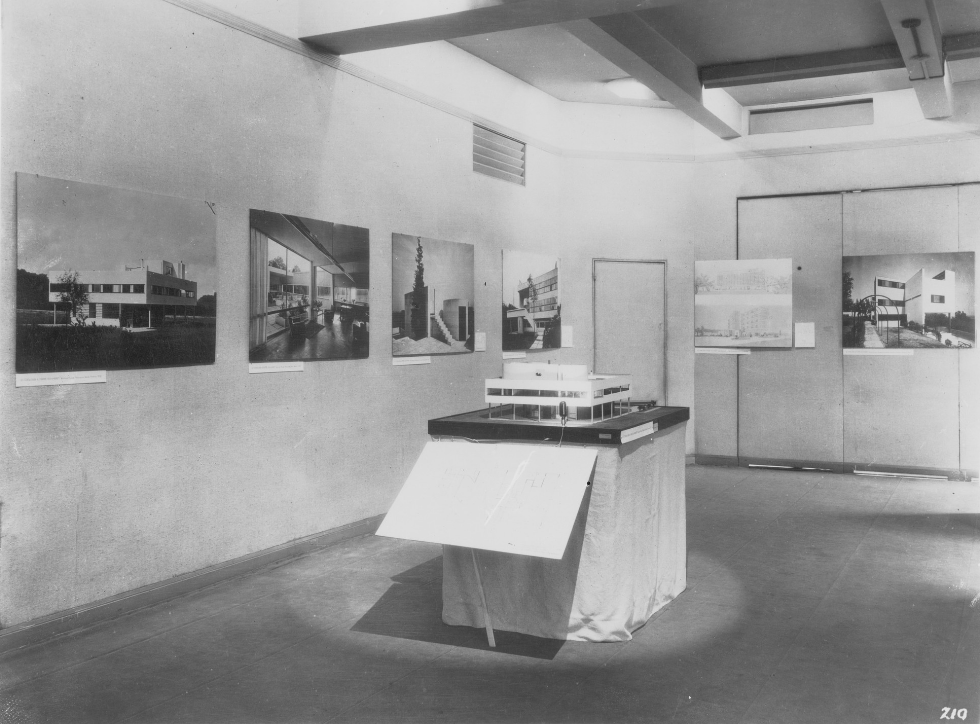
When discussing the principle of technical perfection within the international style, the collaborators discuss note a negative aspect of the principle:
The negative or obverse aspect of this principle is the elimination of any kind of ornament or artificial pattern. This lack of ornament is one of the most difficult elements of the style for the layman to accept. Intrinsically there is no reason why ornament should not be used, but modern ornament, usually crass in design and machine-manufactured, would seem to mar rather than adorn the clean perfection of surface and proportion.
— Johnson and Hitchcock, 1932
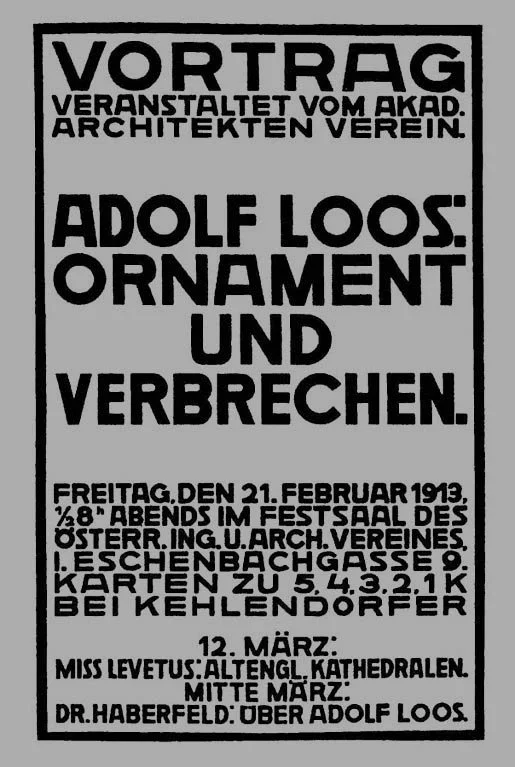
An early edition of Ornament and Crime, 1913
However, while Henry-Russell and Phillip Johnson’s exhibit would set the groundwork for the international style to become a foundation upon which the design practice would build itself, architect Adolf Loos’ works and writing preempted the modernist movement and became an early pioneer of modernist principles through his architecture. Notably, Adolf Loos articulated his vision for design in his 1908 manifesto Ornament and Crime.
The manifesto articulated Adolf Loos’s perspective on ornament in face of the rapid dominance of the industrial revolution, and by extension the birth of capitalism, in the production of commodities and craft. Explicitly, Loos frequently discards the importance of ornament in the life of the 'Modern Man' and frames ornament as a form of arrest in cultural progression and advancement. However, it is quickly apparent within the essay that the definition of ornament, in the eyes of Loos, extends to any expression of visual culture that might tie to cultural identities or histories.
“I have made the following observation and have announced it to the world: The evolution of culture is synonymous with the removal of ornament from objects of daily use. [...] In a highly productive nation ornament is no longer a natural product of its culture, and therefore represents backwardness or even a degenerative tendency. [...] Ornament can no longer be borne by someone who exists at our level of culture. It is different for people and nations who have not reached this level.”
— Adolf Loos, 1908
In early modernist circles, industrialization was received as a liberating force, through which the optimization of labor would allow laborers freedom from their labor.
Modernity at its core is a design philosophy focused on the advancement of society through capitalist industrialization and replaces cultural expression with the pursuit of productivity and industrialized efficiency.
Loos declares ornament to be a crime for the modern man, thinking ornament (cultural expression) to be a force of entropy that erodes the lifetime of any commodity and dooms it to irrelevance. Loos, Johnson, and Hitchcock all shared the same understanding of ornament and desired modernism to create ‘neutral’ artifacts that can endure into the future as timeless objects until they wear away become and unusable.
Early Modernists were seeking a new style of making that washed itself of cultural attachments. In the same ways that modern design naturally is infused with the cultural perspectives of our times, Ornament and Crime suffers the same issues.
Objectively Loos’s book is a work of writing that is guided by white supremacist perspectives of the era that tie into Loos’s criminalization of 'ornament' (visual-cultural attachments), with the text being dismissive of non-white (and in Loos’s terms 'primitive') cultures.
With these texts as a foundation for modernism as a school of thought, one which has been the prevailing standard for design in professional and academic settings, the issues of whiteness, purity, and exclusion have become a problem within modern visual culture as well.